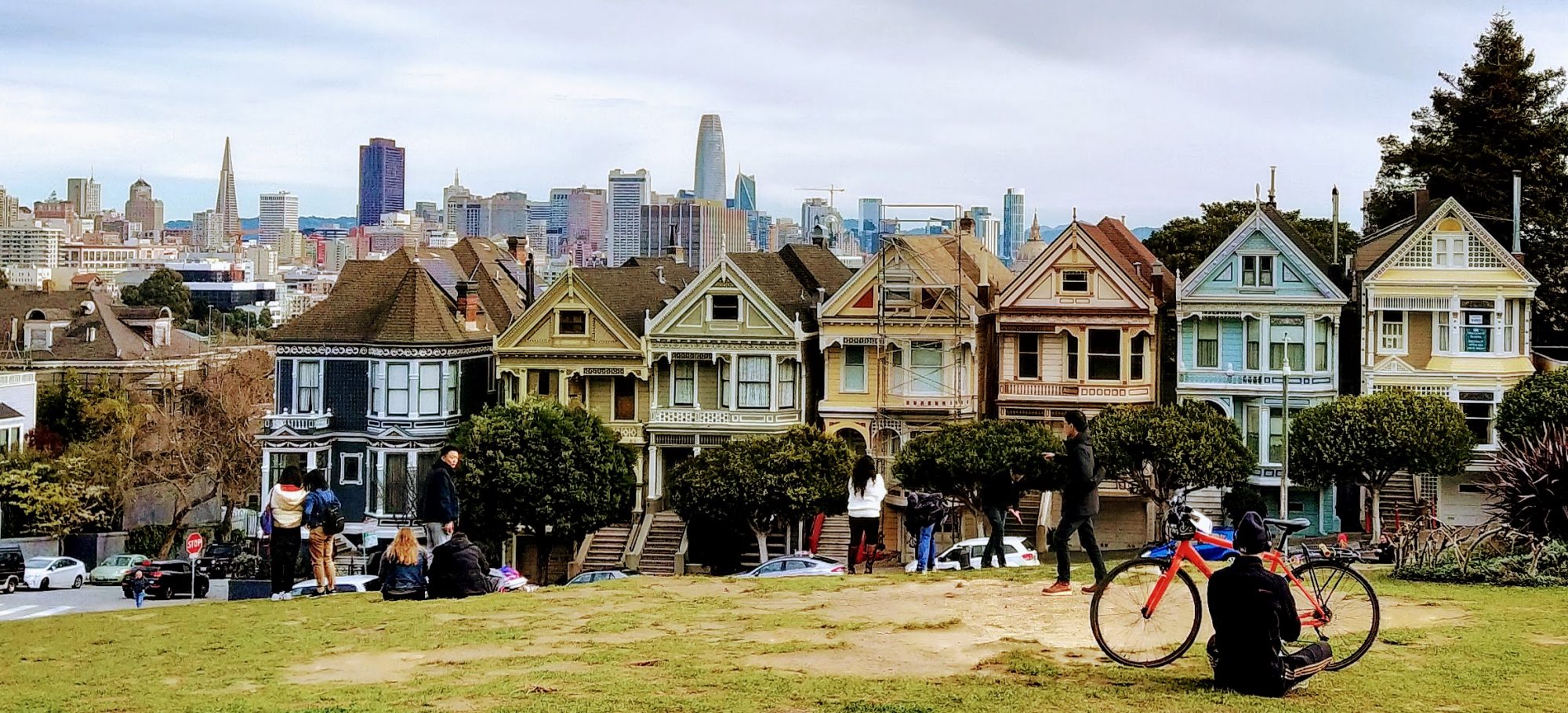

Union Square

Union Square has a history deeply tied to San Francisco’s identity. It was officially designated as a public plaza in 1850 by the city’s first mayor, John Geary. At the center of the plaza stands the Dewey Monument, built in 1903 to honor George Dewey and his victory at the Battle of Manila Bay during the Spanish-American War.


Over time, this large public plaza became a hub for art installations, live performances, theaters, historic hotels, and seasonal events. Surrounding the square, you’ll find a mix of luxury brands, department stores, boutique shops, historic hotels, and art galleries—making it a paradise for shoppers. It’s well-connected by public transport, including cable cars, making it a convenient base for exploring the city.


More on Ruth Asawa’s San Francisco Fountain
One of the hidden gems of Union Square is Ruth Asawa’s San Francisco Fountain, a remarkable public artwork commissioned by the Hyatt and completed in 1972. Composed of 41 bronze panels, the fountain presents a whimsical map of San Francisco, featuring iconic landmarks such as the Golden Gate Bridge, Fisherman’s Wharf, the Ferry Building, and the Palace of Fine Arts, alongside playful surprises like Snoopy, Superman, and characters from The Wizard of Oz. What makes the fountain especially unique is its collaborative creation: Asawa invited local residents and more than 100 children to help model the designs, transforming the work into a celebration of community. The result is both a tribute to the city and a lasting reminder that great public art can truly belong to everyone.
Nowadays, it is also home to many homeless people, and they can be seen wandering around the square and nearby malls. Although Union Square beautifully blends shopping, culture, and city energy—perfect for a quick visit or a stroll—it can feel a bit uncomfortable at times, even during daylight.

Using the cable car, we reached our first stop, the Nintendo store in Union Square. We explored the store, played games, and purchased a few items of merchandise.

Since it was already past lunchtime, we decided to head inside Macy’s, located opposite the square. It was a relief to be indoors in the scorching heat. We freshened up and enjoyed food and coffee at Starbucks overlooking Union Square.


After relaxing, we stepped out to the plaza, soaked in the charm of the place, enjoyed some game installations, and clicked a few pictures. Mihir mentioned that this place looks absolutely magical at Christmas. We wandered around the area and later took a Waymo ride to reach the hotel.
Waymo Ride

Waymo is an app-based taxi service similar to Uber, but these cars are fully driverless. They operate as autonomous vehicles powered by advanced sensors and AI, making the ride smooth, futuristic, and surprisingly normal.
It had been on our list from the moment we heard about it. It was quite an experience and, at the same time, made us nervous for the first couple of minutes. We booked the ride using the app from Union Square to our hotel. The car arrived, we settled in, and entered the code on the screen to start the ride. It was a slightly scary thought that there was no one in the driver’s seat, yet the car moved smoothly. After the initial nervousness, we truly began to enjoy the experience.

Waymo rides in San Francisco are sometimes cheaper than regular app-based cabs. When we visited the city, they used to operate in limited areas only.
Cable Car and Museum
The San Francisco Cable Car system is one of the most iconic, historic, and must-do experiences for visitors.
Introduced in 1873 by Andrew Smith Hallidie, cable cars were designed to tackle the city’s steep hills and make commuting easier. Unlike regular trams, these cars do not have engines—they are pulled by continuously moving underground cables.
Learn More About the History of San Francisco’s Cable Cars: https://www.sfmta.com/getting-around/muni/cable-cars/cable-car-history
Today, only three lines are operational—Powell–Hyde, Powell–Mason, and California Street—but they are preserved as a National Historic Landmark. The ride itself is as much about the experience as it is about the transport: standing on the side, hearing the bell ring, and gliding past famous streets.


We took the iconic Powell–Mason line from the turntable at Taylor & Bay Street to reach Union Square. To our surprise, there were no queues around 01:30 p.m. We purchased $9 tickets from the ticket vending machine, watched the cable cars being turned on the turntable, and hopped onto one. Some people purchased tickets directly from the conductor using exact change, but we noticed a couple who didn’t have the exact amount, and the conductor happily gave them change.

I must admit, the street views from the cable car ride were amazing. It must be even more beautiful in the morning or around sunset.

Initially, we had planned to visit the San Francisco Cable Car Museum, but Mihir mentioned that it can get quite noisy, and since Yuven doesn’t like loud sounds, we decided to skip it.
The museum, located on Nob Hill, opened in 1974 and showcases the evolution of the cable car system. Visitors can see historic cable cars from the 1870s and learn how Hallidie revolutionized transport in 1873. It is also the actual powerhouse where the underground cables are operated—you can watch the massive wheels and cables in action, making it both educational and fascinating.


Wrapping Up Our Experience
This covers everything we planned and explored around Union Square.
If there are any other places in this area that you think we should visit, do let me know—I’d love to add them to our list for the future.
Stay tuned for the next post in this San Francisco travel series, where I’ll share the next set of places we explored in the city by the Bay.
If you enjoyed reading this post or found it helpful, please consider liking, sharing, and subscribing for more travel stories, tips, and experiences.
If you’re planning a trip to San Francisco, you may also enjoy exploring Fisherman’s Wharf and Pier 39—two of the city’s most iconic waterfront attractions. Read about our experience here: